
October 4, 2026
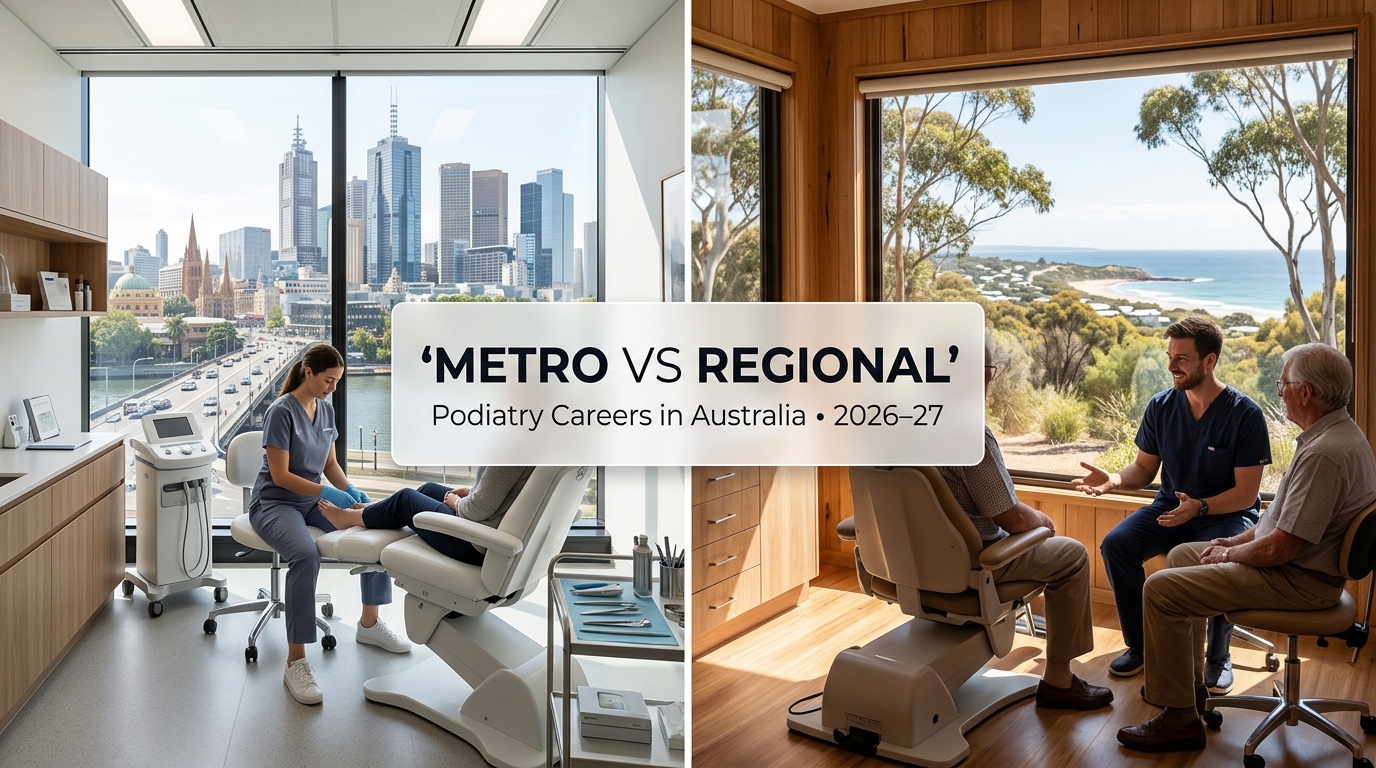
Metro vs Regional Podiatry Jobs in Australia: Pay, Lifestyle and Career Prospects (2026–27)
Podiatry Career Guide · 2026–27
Scroll to explore
Metro vs Regional Podiatry Jobs in Australia: Pay, Lifestyle and Career Prospects (2026–27)
Sydney clinic or regional hospital? Most podiatrists start by asking which one pays more.
8 min read
Updated October 2026
Australia-wide
Metro
Sydney · Melbourne · Brisbane
VS
Regional
Country towns · Remote communities
Fair question. Annoyingly, nobody publishes a reliable national answer. There’s no neat “metro podiatrists earn X, regional podiatrists earn Y” table anywhere. What does exist is better than a single number: award rates, incentive schemes, workforce counts and a proper survey of how podiatrists actually live and work. Put those together and a clear picture emerges.
The award rates
First, the pay floor
If you’re in private practice, you’re most likely covered by the Health Professionals and Support Services Award. It got a major overhaul this year. From the first full pay period on or after 1 October 2026, your minimum depends on your qualification (podiatry sits at AQF level 7) and your years of experience (FWC determination PR814029).
Here are the minimums, before super. Annual figures are the weekly rate × 52:
From the first full pay period on or after 1 Oct 2026
Before super
| Classification | Weekly | Annual |
|---|---|---|
| Level 1First year | $1,308.80 | $68,058 |
| Level 1Seventh year and beyond | $1,689.50 | $87,854 |
| Level 2.1Senior clinician · specialist · supervisor · educator | $1,945.40 | $101,161 |
Two details are easy to miss. Level 2.1 isn’t a “you’ve been here a while” level. It’s tied to what you actually do: senior clinician, specialist, supervisor or educator work. And your years of experience count across your whole career, not just at your current employer. Changing jobs doesn’t reset your clock.
These numbers will move. The award restructure has four more staged increases coming on 30 June in 2027, 2028, 2029 and 2030. Separately, the 2026 Annual Wage Review added 4.75% (FWC decision), which is already baked into the table above. Future reviews will stack on top.
Staged increases:
30 Jun 2027
30 Jun 2028
30 Jun 2029
30 Jun 2030
Here’s the catch for this article. The award has no metro rate and no regional rate. A Sydney postcode doesn’t change your minimum, and neither does a country one. Location only starts to matter once an employer offers more than the minimum — and that’s where the interesting stuff is.
One more thing: public hospital podiatrists are usually under state agreements, not this award. If that’s you, check which instrument applies.
The honest answer
So, do regional podiatrists earn more?
Not automatically — and anyone who says otherwise is guessing.
Jobs and Skills Australia doesn’t publish a median pay figure for podiatrists at all, let alone a regional split. Job boards give a rough guide, and they roughly agree. Indeed reports an average of $107,917. CareerFAQs, citing SEEK, lands near $107,000, with a range of $85,000 to $130,000. Useful as a ballpark. Not a metro-versus-regional comparison.
$107,917
Indeed average salary
≈ $107,000
SEEK median (via CareerFAQs)
$85k – $130k
Typical advertised range
What is well documented is incentive money:
NSW
up to $20,000/ year
The Rural Health Workforce Incentive Scheme is scaled by how remote the location is. Packages can include relocation help, housing and extra leave. Each local health district decides which roles qualify, so don’t assume every vacancy comes with it.
QLD
Rural & remote allowances
Queensland Health lists rural and remote allowances among its allied health benefits.
There’s also a telling number from a Monash-led survey of 1,129 podiatrists (2017–2020):
Satisfied with their pay
Rural respondents72%
Metro respondents66%
Monash-led survey of 1,129 podiatrists, 2017–2020
Tempting to read that as “regional pays better”. But satisfaction is a mood, not a payslip. It can come from benefits, workload and expectations as much as salary.
SEEK listings
What the ads actually say
Advertised salaries show what employers are hoping to attract candidates with, not what people take home. Here are three examples from SEEK listings:
Hobart, TAS
Full time
$90,000–$135,000
Advertised salary range
Robinvale, Mildura & Murray, VIC
Contract / temp
$94,320–$103,700
Advertised salary range
Sydney, NSW
Not stated
$130,000–$150,000
Advertised salary range
Please don’t read these as “Sydney pays more”. The roles aren’t like-for-like. The top of a range tends to go to experienced clinicians, and a contract position doesn’t come with the leave a salaried one does.
Comparing a $94,000 regional ad with a $130,000 city ad tells you about two different jobs, not two different postcodes.
Workforce data 2024
Where the podiatrists actually are
The 2024 national workforce data counts registered, employed podiatrists by Modified Monash category (MM1 is a big city; MM7 is very remote). These are headcounts, not full-time equivalents.
MM1
4,265
Metropolitan
MM2
488
Regional centres
MM3
396
Large rural towns
MM4
193
Medium rural towns
MM5
145
Small rural towns
MM6
39
Remote communities
MM7 (very remote) has no published headcount, so it’s left out.
1 in 4
podiatrists work outside metro areas
16 vs 6–10
per 100,000 people — major cities vs outer regional & remote
Just under a quarter of podiatrists work outside metro areas. Earlier national estimates put supply at about 16 podiatrists per 100,000 people in major cities, against 6 to 10 in outer regional and remote areas. Fewer colleagues per patient is the plain reality of regional practice.
Podiatry is listed as an occupation in shortage nationally and across the states and territories in the 2025 Occupation Shortage List, which can create opportunities for qualified applicants. Regional employers may face additional recruitment challenges where the local workforce is smaller.
Lifestyle & trade-offs
What day-to-day life looks like
The Monash survey is the best recent national look at this I could find, though it predates 2026. It’s worth reading closely, because the trade-offs aren’t the ones you’d guess.
Leave
Rural98%
Metro81%
98% of rural respondents had paid annual leave, against 81% in metro. The authors link this to employment models. If you’re a contractor keeping a share of fees and covering overheads, paid leave generally isn’t part of the deal, so read the contract before the brochure.
Professional growth
Rural · CPD “very good”41%
Metro · CPD “very good”50%
41% of rural respondents rated their CPD opportunities “very good”, against 50% in metro. And 40% reported good support from advanced-skill podiatrists, against 46%. Cities tend to have more specialists down the corridor. A regional role may hand you a broader caseload sooner, but that depends entirely on the employer.
Burnout & job satisfaction
MetroRegionalScores were similar
Scores were similar in both settings. Moving to the country doesn’t cure burnout, and the city doesn’t cause it.
Family
Rural · partner prospects46%
Metro · partner prospects38%
46% of rural respondents said their partner had poor job prospects locally (38% in metro), and half said school choice was inadequate. A large regional centre and a tiny rural town are very different places, so research the actual location, not the category.
Cost of living
Will a regional salary stretch further?
Rent is where the gap shows up. Cotality put June 2026 median rent at $841 a week in Sydney and $641 in Melbourne. That’s a $200 weekly difference between two capital cities, before anyone mentions a regional town. In March 2026, median regional rent was $612 a week against $724 across the capitals, about $110 less.
Sydney
$841/ week
Median rent · June 2026
Melbourne
$641/ week
Median rent · June 2026
Regional Australia
$612/ week
Median rent · March 2026
≈ $110 less than capitals ($724)
Source: Cotality, June 2026 (regional figures March 2026)
Don’t bank that saving yet. Cotality also warns that regional markets are hitting affordability ceilings, with some regional households spending over 35% of income on rent. Before you accept an offer, look at actual rentals near the workplace, and add up travel and childcare too.
The decision
So which should you choose?
Metro tends to suit you if you want specialist mentors, a deeper CPD calendar, or a partner whose career needs a bigger job market. Regional tends to suit you if you want incentive money, a wider caseload and more autonomy early on.
Metro may suit you if…
- You want specialist mentors nearby
- You want a deeper CPD calendar
- Your partner’s career needs a bigger job market
Regional may suit you if…
- You want incentive money (up to $20k/yr in NSW)
- You want a wider caseload, sooner
- You want more autonomy early on
But the setting matters less than the job itself. A well-supported regional role can beat a poorly supported city one — and the reverse is just as true.
Before you sign anything, ask:
1
Pay structure: is it salaried, or a percentage of billings, and does the figure include super?
2
Leave: is paid annual and sick leave in the contract?
3
Relocation: are relocation, housing or incentive payments in writing, and what conditions come with them?
4
Support: who supervises you, and is CPD time and funding included?
5
Classification: which award level and years of experience have they assigned you?
Get the answers in writing. A verbal “we’ll sort that out” isn’t a payment term.
Talk to Mates Health
Still torn between the city and the country? Mates Health recruits healthcare professionals across Australia. Our team can talk you through the roles currently open, how employers are structuring pay, and what to check before you relocate. Contact us and tell us where you’re thinking of working and what experience you bring.
Start a conversationGeneral information only, not financial, tax, legal or employment advice. Award coverage and rates depend on your classification. Data and survey figures have different reference periods. Confirm pay rates, vacancy details and incentive eligibility before deciding. Information current as at October 2026.