
August 28, 2026
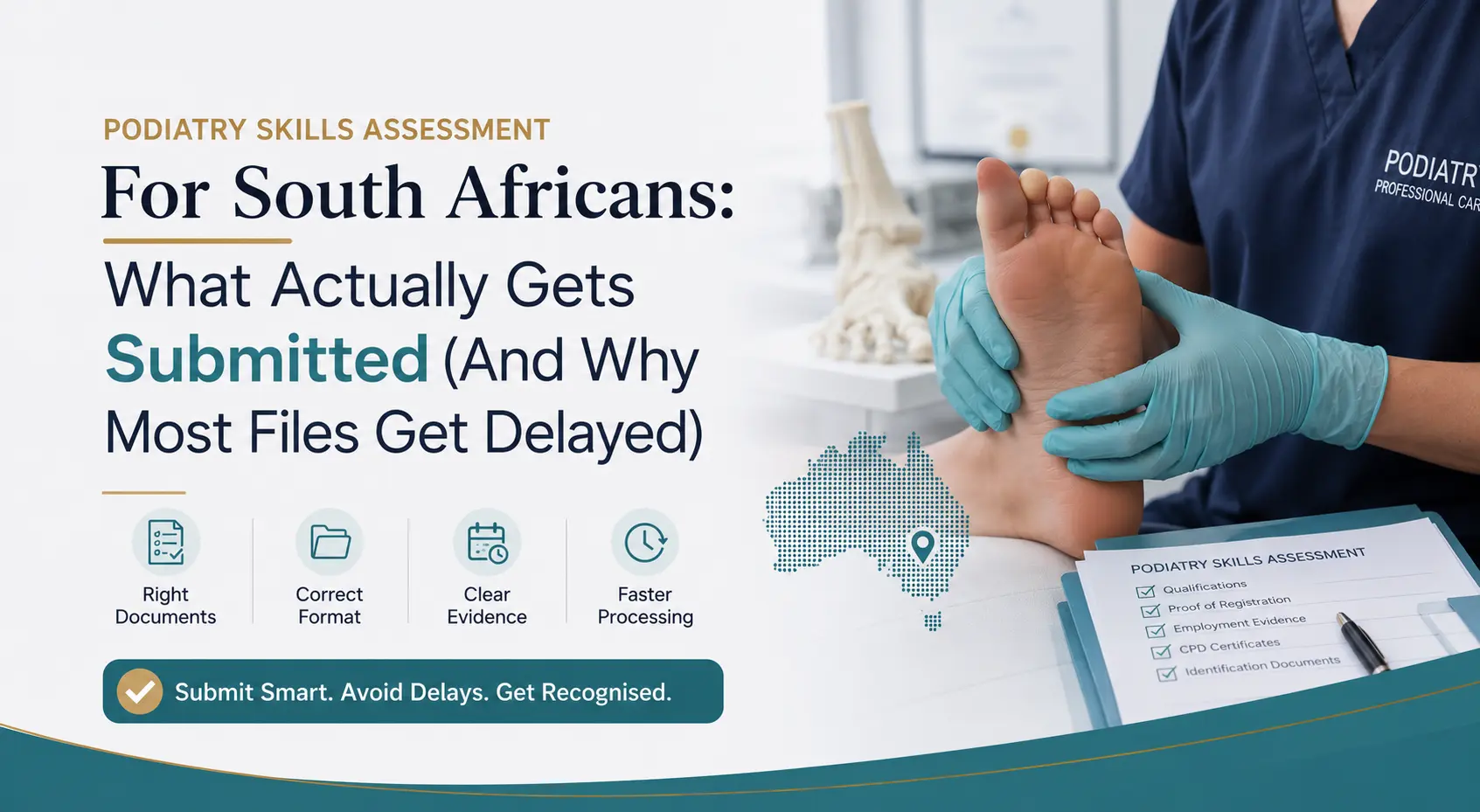
Podiatry Skills Assessment for South Africans: What Actually Gets Submitted (And Why Most Files Get Delayed)
Copied!
Podiatry
SA → AUS
2026 Guide
10 min read
Podiatry Skills Assessment for South Africans
What Actually Gets Submitted
And why most files get delayed — the real breakdown nobody gives you.
0
Process, not two
0
Key documents
0
Common mistakes
It's midnight, you've typed "podiatry skills assessment Australia" into Google for the fifth time this week, and every result is either about nurses, or written by someone who's clearly never touched an AHPRA portal. Sound familiar?
Here's the thing nobody tells you upfront: podiatry doesn't work like most of the other health professions you'll read about. There's no separate "skills assessment" sitting next to your registration application. It's one process wearing two hats. Once you understand that, half the confusion disappears.
So let's get into what actually happens — who's assessing you, what lands in your file, and where South African applicants keep tripping over the same three or four things.
Before you go further, bookmark our complete guide for South African podiatrists moving to Australia — this article is the deep dive into one piece of that bigger picture.
Section 01
Forget Everything You Read About ANZPAC
If you've spent any time in Facebook groups or old forum threads, you've probably seen ANZPAC mentioned — the Australian and New Zealand Podiatry Accreditation Council.
ANZPAC
Close that tab. That body stopped being the relevant authority a while ago.
Today, the Podiatry Board of Australia, operating through AHPRA (the Australian Health Practitioner Regulation Agency), is the body that actually assesses you. And unlike physiotherapy or nursing, podiatry has folded the skills assessment into general registration itself. You apply for registration. If it's approved, your Certificate of General Registration is the document the Department of Home Affairs accepts as your migration skills assessment.
You apply for
Registration
If approved
Certificate
Accepted as
Skills Assessment
One process. Two outcomes. No separate assessment.
People still go hunting for a standalone "podiatry assessing authority" because that's how it works for other professions, land on old ANZPAC pages, and burn a month before someone points them in the right direction. These arrangements do get revised without much fanfare — always confirm the current pathway directly on AHPRA's registration process page before you commit to anything.
Want the full walk-through of the registration process itself, step by step? That's covered in our HPCSA to AHPRA registration guide for South African podiatrists — read it alongside this one.
Section 02
Does Your Degree Even Count?
Before you spend a weekend hunting down certified transcripts, answer the question that actually matters first: is your South African qualification recognised at all?
Mostly, yes — South African podiatry training carries real weight with the Board. Podiatry is listed on the Skilled Occupation List under ANZSCO code 2526 (Podiatrist), and the Podiatry Board's registration standard for qualified applicants from overseas is designed to accommodate Commonwealth-trained practitioners.
But there are nuances depending on when and where you studied, and we've unpacked all of it in South African podiatry degree recognition in Australia: does your qualification count? — worth five minutes before you go any further.
Section 03
What Actually Goes Into the File
None of this is glamorous. It's paperwork, and there's a fair bit of it. Click each item as you gather it:
0 / 5
Identity documents
Your passport — and if your surname on your degree doesn't match your current legal name (married post-graduation?), you'll need your marriage certificate or DHA name change documents bridging that gap.
Your podiatry qualification
Degree certificate + full academic transcript spelling out clinical hours logged. Most SA applicants come through the University of Johannesburg's four-year Bachelor of Podiatry — currently the country's main training route. Your transcript needs to clearly show the Board's required competencies are covered.
HPCSA registration — verified directly from HPCSA
#1 trapNot a PDF you scan yourself — it has to come straight from the Health Professions Council of South Africa. You'll need to request verification through their online services portal. Self-submitted registration evidence gets rejected outright by AHPRA, and HPCSA's own processing time for these requests is something you need to build into your timeline, not discover halfway through.
English language evidence
Not automaticBeing from SA doesn't exempt you — it's about where your schooling and tertiary education actually happened. If you can't clearly tick an exemption box, you'll need one of: IELTS Academic, OET (specific to healthcare), PTE Academic, or TOEFL iBT. The required band scores were realigned in 2026 — if the number you're working from came from a blog post written two years ago, it's wrong.
Reference letters
If you're leaning on prior clinical experience — these need to follow a fairly specific format, covering genuine, paid clinical work that can be independently verified. Vague letters from a former supervisor won't cut it. The Board's international applicants page has guidance on what they're looking for.
Click items to track your progress
Not sure if your transcript has enough detail?
We review South African podiatry transcripts against AHPRA's requirements every week. A quick look before you submit can save you a month of back-and-forth.
Section 04
What Happens After You Hit Submit
No interview. No practical exam. Nobody watches you treat a patient.
It's entirely desk-based — someone at the Board sits with your qualification, your transcript, and your registration history, and lines it up against the Podiatry Board's registration standard for what's expected of an Australian-trained podiatrist.
Scan quality
Blurry phone photos and CamScanner exports get bounced. Clear, high-resolution colour scans of your originals are the baseline — not the bar to clear, the minimum to even be considered. AHPRA's supporting documents guide spells out their requirements.
Verification source
Anything meant to arrive "from the source" — HPCSA registration, transcripts — has to come from the issuing body itself. Not forwarded through your personal inbox, no matter how official it looks. AHPRA uses the international applications verification pathway for this.
Realistic timelines
Once your file is genuinely complete, you're looking at several weeks minimum — and that clock starts when everything's actually in, not the day you hit submit with half your documents still pending. You can check AHPRA's published processing times for current benchmarks.
Expiry math almost nobody thinks about: your assessment outcome is valid for a set number of years, but your visa pathway has its own separate rules about how current that assessment needs to be at the point you lodge. Nobody cross-checks those two dates for you. Our Australian visa pathways for South African podiatrists guide breaks down which routes are actually available and how the timing typically plays out.
If the outcome comes back unsuitable, it's not game over — there's an appeals process, and the Board will tell you exactly which criteria weren't met. What they won't do is tell you how to fix it. That part's entirely on you.
Straight from the source: Podiatry Board of Australia — Overseas Trained Podiatrists. Bookmark it — these pages get updated more quietly and more often than people expect.
Section 05 — The Danger Zone
Where Files Actually Fall Apart
Having watched this play out across allied health fields for a while now, it's almost never the qualification itself that's the problem. South African podiatry training holds up fine. What actually derails people is much smaller and much more avoidable:
A transcript that doesn't spell out clinical hours in enough detail — the Board's registration standard is specific about what they need to see
An HPCSA verification email sent from someone's personal Gmail instead of an official HPCSA address
An English test result that's technically expired by the time the rest of the file catches up — check AHPRA's current validity period
A name mismatch nobody noticed until week six
Every single one of those is fixable before submission. None of them are fixable after a rejection without losing weeks.
This is exactly the gap Mates Health sits in. We work specifically with overseas-trained podiatrists on AHPRA and registration paperwork — nothing else, just this. Having someone who reviews these files every week look at yours before it goes in is usually the difference between a clean six-to-eight-week turnaround and an exhausting back-and-forth over one missing letter.
Get your file reviewedSection 06
Quick Answers to What People Actually Ask
Do South Africans automatically skip the English test?
No. Being from South Africa doesn't exempt you — what matters is where your schooling and degree were actually conducted and assessed. Check AHPRA's current exemption categories before assuming either way.
How long does the whole process take?
Once your file is complete and everything's submitted correctly, realistically several weeks at minimum. You can check AHPRA's published processing times for current benchmarks. Missing or incorrectly verified documents are what stretch this out to months.
Is ANZPAC still involved in any of this?
No. That's outdated information still floating around older forums and Facebook groups. The Podiatry Board of Australia, through AHPRA, handles this now.
What's the single biggest reason files get delayed?
Verification that doesn't come directly from the source — HPCSA registration or transcripts sent from a personal email instead of the institution itself. See AHPRA's international applications verification requirements.
Does my registration outcome expire?
Yes, it's valid for a set period, and your visa pathway has its own separate currency requirements. You need to check both dates line up — nobody does that cross-check for you automatically. Our visa pathways guide covers this in detail.
Got a question that's not covered here?
We answer podiatry registration questions from South Africans every day. No charge, no obligation — just honest answers from people who know the process.
Section 07
What's Actually Waiting on the Other Side
Getting registered is the gate. Here's what's worth thinking about once you're through it:
The Honest, Short Version
ANZPAC is gone. It's the Podiatry Board of Australia and AHPRA now, and your registration outcome doubles as your migration skills assessment — one process, not two.
HPCSA verification, a properly detailed transcript, and English proficiency evidence (unless you clearly qualify for an exemption) are what actually hold your file together. There's no exam. But document quality and where your verification comes from will decide, more than anything else, whether this takes six weeks or six months.
None of this paperwork is exciting. Get it right the first time, though, and you'll spend a lot less energy fighting forms and a lot more time actually picturing your life once you're there.
Want someone who does this every week to check your file?
This is genuinely the entire reason we exist.
Share this guide